

"Thank You for Your Support": Neil Gaiman's Response to Rape Allegations Is the DARVO Playbook
"By denying, attacking and reversing perpetrators into victims, reality gets even more confusing and unspeakable for the real victim." —Jennifer Freyd

What’s ahead:
Gaiman’s response follows the DARVO pattern, a documented tactic that protects abusers.
Celebrity worship creates the infrastructure that makes these denials work.
Promoting a book while denying rape allegations reveals the impunity fame provides.
“Believe survivors” means refusing to let power imbalances determine whose story counts.
Disclaimer: If this is the first time you’ve heard that Neil Gaiman has been accused of sexual assault, please stop and go read the Vulture article on the topic or listen to the podcast series, Master: The Allegations Against Neil Gaiman.
Content Warning/Trigger Warning: While I will avoid describing the actions Neil Gaiman is accused of, the subject of this essay is sexual assault and how predators operate.
On February 2, 2026, author Neil Gaiman broke his silence on sexual assault allegations from multiple women. His post was what you’d expect by now. He denied everything, attacked the journalism, claimed he was the victim of a "smear campaign"—and promoted his new book, which he calls "the biggest thing I've done since American Gods".
We are not going to litigate Gaiman's guilt here; the investigative journalism (linked above) did that work for us. What we will do is highlight how celebrity abusers weaponize their platforms and fanbases to evade accountability. And Gaiman's response is a perfect case study in evasion tactics so common they have a name: DARVO—Deny, Attack, Reverse Victim and Offender. Understanding this pattern is strategic because it's how powerful men survive allegations that would destroy anyone without a fanbase to mobilize.
The DARVO Playbook
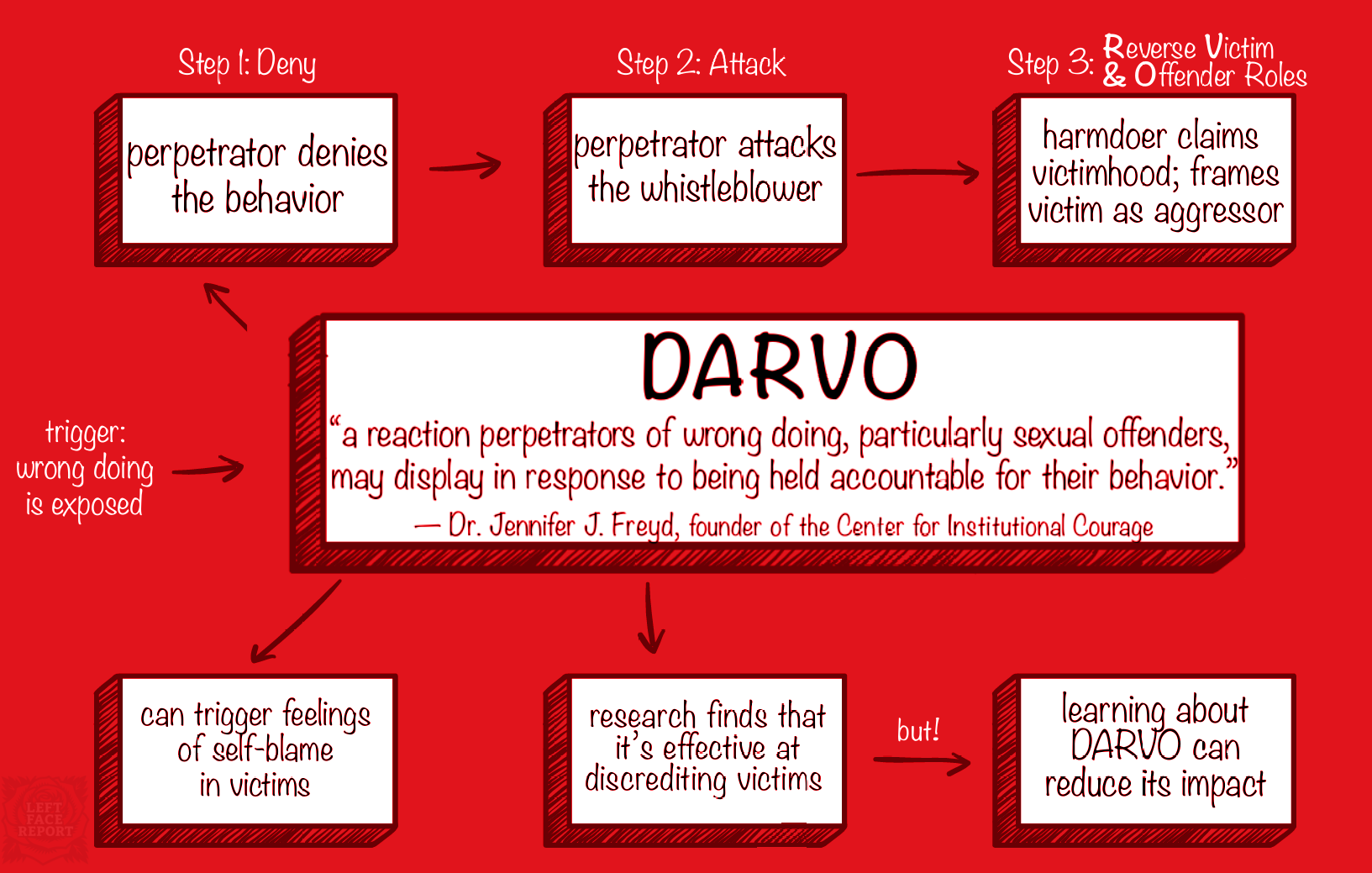
DARVO was coined by psychologist Jennifer Freyd to describe how predators respond when confronted. The pattern is straightforward: deny the behavior happened, attack the credibility of those making accusations, then claim you're the real victim. Research published in 2023 found that DARVO works. When study participants were exposed to a perpetrator using DARVO, they rated the perpetrator as less abusive, less responsible for sexual assault, and more believable compared to participants who weren't exposed to DARVO. They also rated the victim as more abusive and less believable, and expressed less willingness to punish the perpetrator.
Fans have invested emotional energy, identity, and money into these figures. Admitting your hero is an abuser requires confronting your own complicity in elevating him.
Gaiman’s post hits every element:
Deny: “The allegations against me are completely and simply untrue”.
Attack: These are “salacious” claims “spread and amplified by people who seemed a lot more interested in outrage and getting clicks on headlines rather than whether things had actually happened or not”.
Reverse Victim and Offender: He states he learned “firsthand how effective a smear campaign can be,” positioning himself as the target of coordinated harm rather than someone accused by eight women with detailed, corroborated accounts.
The “mountains of evidence” he claims “exist” (i.e. emails, text messages and video evidence that flatly contradict them) remain conveniently unproduced. What we do have is detailed investigative reporting from outlets like Vulture documenting patterns of coercion, manipulation, and abuse. We have testimony showing Gaiman pressured at least one victim to recant, used suicide threats to manipulate her, and convinced her to tell his therapist (whom he was paying) that everything was consensual. We have evidence that even Amanda Palmer, Gaiman’s ex-wife, knew enough about his behavior to warn victims beforehand.
The truth is irrelevant to DARVO. It just needs to be plausible and a large enough audience to accept it.
Celebrity Worship as Infrastructure
Celebrity culture protects powerful men accused of violence systematically. Gender studies scholar Karen Boyle argues that even when these men fall, “they fall spectacularly, with all eyes on them… their stories dominate”. The focus stays on the accused, not the victims. The narrative becomes about whether we should still love their art, whether they can be redeemed, whether the accusations are “really” credible enough to warrant consequences.
This operates like what researcher Dr. Jamilla Rosdahl calls a “modern panopticon”—powerful men use gendered power and social status to trap victims within an invisible prison and extend control to entire communities. Fan loyalty becomes a weapon. Studies of sports fans found they excuse deviant behavior as long as their team's star is winning. The same dynamic plays out with celebrity authors. Fans have invested emotional energy, identity, and money into these figures. Admitting your hero is an abuser requires confronting your own complicity in elevating him.
Whether he's coordinating with this account, exploiting a useful idiot, or running the page himself, the effect is the same: outsourcing/appearing to outsource his defense to someone who can make claims he can't without risking defamation liability.
Gaiman knows this. His work is embedded in people’s childhoods, their identities as readers, their sense of what good storytelling means. Didn’t you love Coraline? Wasn’t The Sandman so profound and ahead of its time? That emotional investment becomes his shield and sword all at once.
Weaponizing the Fanbase
Neil Gaiman’s post opens by thanking fans for "all your kind messages of support over the last year and a half". He's reminding his audience of their existing loyalty, activating the sunk cost. He pivots to his identity as creator…"when things get tough, make good art," as if continuing to write novels is evidence of innocence rather than the privilege of someone whose career hasn't been destroyed by credible allegations. He mentions being "a full-time Dad" (half of every month) because humanizing himself makes it harder for fans to reconcile the person they've imagined with the accusations.
Then he promotes an anonymous Substack called "TechnoPathology" that defends him. He claims he's "had no contact with TechnoPathology" but conveniently links to their work, driving his massive audience to consume a defense he cannot be held accountable for amplifying. The anonymous account describes itself as "the home of the Neil Gaiman Is Innocent Research Project". Whether he's coordinating with this account, exploiting a useful idiot, or running the page himself, the effect is the same: outsourcing/appearing to outsource his defense to someone who can make claims he can't without risking defamation liability.
Marketing a Book While Denying Rape Allegations
Gaiman then does a thing any normal person would do if accused of sexual assault, he teases a new book. He describes it as bigger than American Gods, already longer than The Ocean at the End of the Lane, a project so consuming and meaningful that readers should be excited despite everything. The subtext is clear: his creative output matters more than the women he's accused of harming. He's gambling that fan investment in his stories will outweigh their concern for his victims. And if Harry Potter fans have taught us anything about defending creators who are horrible human beings, he's probably right.
When he frames allegations as a “smear campaign,” he’s counting on fans to accept his framing rather than confront the pattern of harm eight women describe.
This is the move Harvey Weinstein made when he granted interviews touting his contributions to society and charity work while facing over 80 accusations of sexual harassment, assault, and rape. This is the move every celebrity accused of sexual violence makes when they pivot to their achievements, their humanity, their art. It works because celebrity culture is fundamentally patriarchal and will center men even when they're found to be perpetrators.1
What makes this especially grotesque is the timing. Gaiman stayed silent for a year and a half after allegations first emerged in July 2024. He waited until investigative journalism had already published, until the news cycle had moved on, until his most loyal fans had already decided whether they believed him. This post isn't for people on the fence, people looking for the truth. It's for the people who never doubted him, who need any crumb of excuse to justify their continued support. It's permission to keep buying books, keep defending him online, keep dismissing his accusers as liars chasing clicks.
Dark Horse Comics cut ties with Gaiman in January 2025, Amazon dropped him from adaptations of his work, Netflix excluded him from press for The Sandman, and Disney halted development of The Graveyard Book. His agent dropped him. Yet here he is, seventeen months later, still worth millions, thanking supporters and promoting his next project.
↻ If this analysis clarifies something you've been struggling to name, share the link and hit the restack button—it helps reach people who need this framework.
Why “Believe Survivors” Still Matters
The DARVO research reveals something critical: these tactics work specifically because the deck is already stacked. Most perpetrators of sexual violence never face consequences. When they’re confronted, they deploy DARVO because it’s effective at distorting narratives in their favor. A 2024 study found that among people who admitted using DARVO tactics, many genuinely believed they had done nothing wrong. They perceive their behavior as acceptable conduct, which makes them more likely to deny wrongdoing, attack accusers, and claim victimhood.
Gaiman has a platform with millions of followers. He has wealth, legal resources, and a fanbase emotionally invested in his art and his innocence. His accusers only have their testimony, the trauma of going public, and the knowledge that a significant portion of the public will never believe them no matter how much evidence exists. When he writes that journalism "dismissed or ignored" the evidence, he's banking on his audience never reading that journalism. When he frames allegations as a "smear campaign," he's counting on fans to accept his framing rather than confront the pattern of harm eight women describe. But hey, it worked for Donald Trump, why not Neil Gaiman?
"Believe survivors" is not about abandoning due process or presuming guilt without evidence. The evidence is already here. Besides, “due process” is for courts. Are you on jury duty? Be honest and realize that you constantly make judgements based on available evidence all the time in your life.
What 'believe survivors' means: refusing to let DARVO work. It means recognizing that powerful people accused of sexual violence have every structural advantage: money, platforms, fan loyalty, and the cultural mythology about false allegations. All survivors have is their word and the courage to use it.
I'll leave you with this: when someone responds to detailed allegations of rape by thanking their fans and promoting a book, that should be evidence enough.
What accountability looks like in practice:
Stop promoting his work. Fandom is not apolitical. Your money and attention are material support.
Share the investigative journalism, not his denials. The Vulture reporting, the podcast examining the allegations—those deserve circulation.
Challenge friends who defend him. When someone says “we don’t know what really happened,” you can respond: “Eight women have testified with corroborating evidence. His response is a documented manipulation tactic.”
Recognize this pattern when you see it again. Gaiman is not unique. This playbook gets used because it works.
The ruling class doesn’t need you to actively defend abusers. It needs you to stay uncertain, to prioritize the art over the harm, to accept that some people are too important to lose. Black History Month, Women’s History Month, every month is the moment to refuse that bargain.
What solidarity looks like in practice:
Share this with someone who needs to understand DARVO tactics
Drop a comment: Have you ever seen DARVO play out successfully for someone who wasn’t a celebrity? How did it play out? Who was their audience?
Subscribe for analysis that names the systems protecting powerful men
HASTA LA VICTORIA SIEMPRE.
Celebrity culture is also racist. There’s a reason Neil Gaiman is still wealthy with a significant following and Jonathon Majors still can’t climb out of that hole. Not that he deserves to be out of that hole, but we all know why he was put there so quickly.