

Kinetic Politics: The Venezuela Strike and the War Over ‘Unlawful’ Orders
The military will not save us. It was never designed to.

On September 2, United States military forces executed a kinetic strike on a small vessel in the southern Caribbean Sea. The Trump administration claimed the 11 people killed were tied to Tren de Aragua, a Venezuelan drug cartel. The strike was part of a surge of U.S. military forces that now includes the aircraft carrier recently deployed to the region, the USS Gerald R. Ford.
Imperialism aside, using that kind of force against a criminal gang, rather than a state actor, blurs the line between law enforcement and war. It is precisely in this gray area where questions of ‘legality’ start to rise. But Donald Trump doesn’t let little things like legality stop him; he is selling the strike as a new, necessary escalation in his “war on drugs.”
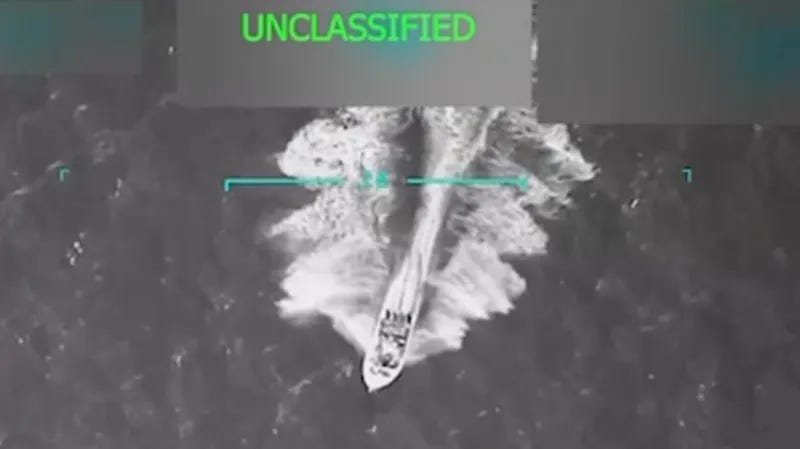
The press asked standard questions the U.S. government should have been able to answer easily. How did you know who was on that boat? How did you know there were drugs on that boat? Who authorized the strike?
While it would be unreasonable to expect the Department of Defense (the constitutionally legal name) to release classified details that would indicate what our military intelligence capabilities are, surely, they have something more than, “Trust me, bro.”
Nope.
Then other details started hitting the headlines, the kind of headlines that make official narratives begin to crack.
As the strikes continued, the Associated Press tracked down identities of the extrajudicially killed and spoke with families and residents in the coastal towns the dead came from. The picture that emerged wasn’t a fleet of cartel ‘narco-terrorists.’ According to reporting, the dead were often disposable labor. It looked more like people struggling in a region built on poverty and exploitation than a formidable opponent worthy of a Ford-class carrier. These were fishermen, laborers, petty criminals, even a former cadet. People risking their lives in a place where making a few hundred extra dollars a month can be the difference between eating and starving.
By early December, reporting indicated more than 20 boats had been destroyed and more than 80 people dead. Are we really meant to believe everyone on every boat was a ‘narco-terrorist’? A direct threat to the security of the world’s wealthiest nation?
And while independent reporting seems to confirm at least some of these boats were moving drugs between Venezuela, Trinidad, and other islands, that doesn’t answer the ultimate question the U.S. wants to dodge. Since when is the penalty for drug trafficking death by missile?
The collateral blowback is already crossing borders. The family of Colombian fisherman Alejandro Carranza has filed a complaint with the Inter-American Commission on Human Rights over the Sept. 15 strike off Colombia’s coast. Colombian President Gustavo Petro has publicly stated that the hit vessel was Colombian with Colombian citizens inside. The White House denies it.
Trump’s administration insists these strikes are lawful acts within an ‘armed conflict’ with narco-terror groups (remember this). Critics keep asking how a war was declared, who gets counted as a combatant, and why the military, not law enforcement, is now the lead instrument of drug enforcement.
The legal war over the strikes
The administration’s story is blunt: these boats are part of a cartel war, and the cartels are effectively enemy armed groups.
But legal experts are not buying it. Their challenge is two-pronged.
First is international law. UN experts have called the strikes grave violations of the right to life and the law of the sea, urging investigations into what they describe as extrajudicial killings. They also explicitly warn against repeating the pattern of U.S. intervention in Latin America.
Second is domestic constitutional law. Senators and representatives have argued the strikes constitute hostilities that require congressional authorization and have introduced a War Powers resolution directing the removal of U.S. forces from hostilities within or against Venezuela that Congress did not approve.
The administration’s defense is the modern U.S. classic: a mix of legal categorization, executive theory, and strategic opacity. Reporting indicates the Office of Legal Counsel drafted a classified opinion reframing drug smugglers en route to the U.S. as terrorist threats and arguing the same rules used in the global war on terror apply here. In a detail that should set off every alarm bell, that legal opinion was reportedly signed after the initial strike, and key military lawyers did not receive access until weeks later.
You can’t read that as a good-faith system trying to restrain violence. You read it as what it is: law being written to catch up to policy, not policy being restrained by law.
Why you should not expect meaningful refusal
So, there you go! If these strikes are illegal, servicemembers are protected if they refuse to carry them out, right?
Wrong.
Here’s what many people, including former CIA agents and retired fighter pilots, need to come to terms with. Disobeying unlawful orders is not something you should ever expect the U.S. military to do in any meaningful, systemic way.
An imperial apparatus would never give its soldiers a real veto over empire. The same state that wants the violence is the state that defines the legality, controls the courts, controls promotions, controls pay, and controls pensions. The “duty to refuse” is reserved for the cartoonish edge cases, the ones that let the institution present morality theater without disrupting the mission. Everything else gets presumed lawful, and anyone who tries to make personal conscience a second chain of command gets punished and replaced.
And while the administration celebrates this strike as a victory for its new aggressive posture, critics argue this ‘shoot first’ mentality will inevitably lead to soldiers receiving orders that cross the line. That fear is exactly what prompted a group of veteran lawmakers to speak up this week. Below is a video posted on Senator Elisa Slotkin’s Threads account:
Technically, they’re correct. The Uniform Code of Military Justice (UCMJ) technically limits obedience to lawful orders. Article 92 punishes failure to obey lawful orders, which is the legal skeleton behind the entire culture of compliance.
However, as stated before, this ignores the fact that the military justice system and international law, for that matter, recognize an extremely narrow duty to refuse manifestly unlawful orders, the cartoonish stuff that any ordinary person would recognize as a crime, wartime or otherwise. Think an order to shoot civilians for sport.
The doctrine is real. The threshold is just intentionally brutal.
In practice, the space between “manifestly unlawful” and “politically useful violence the state can lawyer into legitimacy” is where almost everything important lives.
A servicemember can distrust the mission, fear the consequences, or believe a war is illegal and still get thrown into the woodchipper.
Don’t believe me? Check out these OEF/OIF-era cases:
Camilo Mejía refused to return to Iraq, citing moral outrage and concerns about the war’s legality and U.S. conduct toward civilians. In 2004, he was convicted of desertion and sentenced to one year of confinement, reduced from Staff Sergeant (E-6) to Private (E-1), and given a Bad Conduct Discharge. He was released after nine months for good behavior. Amnesty recognized him as a prisoner of conscience. Note: A Bad Conduct Discharge (BCD) is a serious punitive discharge that often results in the loss of most veteran benefits; it remains part of your permanent record and can significantly limit future employment.
Ehren Watada was the first commissioned officer to refuse deployment to Iraq. He argued the war was illegal and that participation could make him complicit in war crimes. He was charged with “missing movement” and “conduct unbecoming an officer”. His 2007 court-martial ended in a mistrial, and the Army allowed him to resign with an Other Than Honorable discharge in 2009. Amnesty and other advocates criticized the fact that U.S. rules do not recognize selective conscientious objection to a particular war, which helps explain why Watada’s refusal was treated as a discipline problem rather than a genuine legal reckoning.1234
Bowe Bergdahl was a U.S. Army Soldier who left his post in Afghanistan in 2009 and was captured by the Taliban. Bergdahl stated he was trying to get the attention of higher command to address what he viewed as serious problems in his unit’s leadership. He sincerely believed his Battalion commander was sending his units on “suicide missions” and was not being held accountable for misconduct. According to testimony from the investigating officer, Bergdahl said he hoped his disappearance would trigger enough urgency that a general officer would finally hear his concerns. At sentencing years later, he again claimed he left to report misconduct in his unit, not to abandon the mission for its own sake. The Article 32 officer later noted there was “almost unanimous agreement” that Bergdahl left with good, though misguided motives. On July 25, 2023, a federal judge vacated the conviction due to an appearance-of-bias issue involving the military judge, and the Justice Department appealed in 2024. As of the date of this writing, the appeal is still ongoing.
These cases underline the pattern you’re supposed to ignore. When servicemembers break with command for perceived moral or legal reasons, the institution does not treat that as principled resistance. It treats it as a threat to authority and moves to discipline.
The architecture that makes refusal a fantasy
The truth is orders are, by design, presumed lawful. The chain of command controls performance reviews, assignments, promotions, and who gets frozen out. The military justice system moves fast, and a refusal can cost pay, rank, benefits, and career before any outside court or public debate ever gets near the facts. That is not a bug. That is how discipline is manufactured.
Even the legal advisors inside the machine face incentives to rationalize, not rebel. A recent law review analysis argues that judge advocates are embedded within command culture and pressured to provide justifying legal cover under imperfect information, with real career risk for saying no.
Now zoom back out to the Venezuela strikes.
If the Pentagon is willing to construct a classified framework after the fact, and if Congress has to fight for the basic documents explaining who authorized what, then the fantasy that some colonel, captain or private is going to heroically refuse on principle becomes what it always was: a comforting movie scene where you can’t handle the truth.
Snap Back to Reality
An imperial state does not outsource moral veto power to the people holding rifles. It centralizes authority, then manufactures legality around its own needs.
So when Trump’s defenders say the strikes are legal because the administration says they are, that is not just circular logic. It is a confession of how the system works. The same government that wants the violence is the government that staffs the lawyers who bless it. (See: Israel)
If opponents are right, and these strikes violate the law of war and the law of the sea, we are not watching an accidental slide into illegality. We are watching a familiar imperial move: create a new category of enemy, expand executive war powers, and dare anyone to stop you.
If your desperation has you clinging on the hope that “the military will restrain Trump,” you are betting on the wrong institution. The U.S. military is the product of thousands of years of lessons learned. They will (and have!) kill even U.S. citizens if ordered. What makes you think they won’t kill Venezuelans?
The narrow rule is true: a soldier must refuse an obviously criminal order.
The broader reality is also true: the system threatens, isolates, and replaces anyone who tries to treat personal legal judgment as equal to command authority.
The architecture serves to ensure obedience, then to launder that obedience into legitimacy.
So no, the military will not save us from Trump.
Not in Venezuela.
Not at home.
Not anywhere an imperial project needs violence to stay coherent.
The myth of “unlawful orders” is a sedative.
And empire loves a sedated public.
Murphy, Kim. “Army to Discharge Officer Who Refused to Go to Iraq.” Los Angeles Times, 29 Sept. 2009
“Army Officer Who Refused Iraq Duty Is Allowed to Resign.” Associated Press, 27 Sept. 2009.
Amnesty International. “USA: War Objector’s Freedom of Conscience Must Be Respected.” 5 Feb. 2007.
Amnesty International. “USA: Conviction of War Objector Would Violate International Rights.” 9 Oct. 2007.