

"I No Black, I Puerto Rican": The Myth That Keeps Anti-Blackness Alive
"Puerto Rican national discourses about race… simultaneously privilege whiteness, typecast blackness, and silence charges of racism." —Isar P. Godreau

What’s ahead:
The “race isn’t a big deal in Puerto Rico” line protects hierarchy, not harmony
Blanqueamiento (”whitening”) works by making Blackness unspeakable, then calling the silence unity
Colorism in Puerto Rico has measurable consequences, including health
The same script shows up across Latin America, with local variations and the same payoff
People don’t develop a rich color vocabulary in a society where color carries no consequences.
When people say, “I no Black, papi, I Puerto Rican,” they’re drawing a boundary: Puerto Rican on one side, Black on the other. No matter how proud my people are that we are of mixed heritage, that boundary doesn’t appear by accident. It’s been maintained for generations through family language, beauty standards, rejection of Black identity and institutional incentives that reward distance from that Blackness.
Black History Month is a good time to shine a light on what the “we don’t do race in Puerto Rico” crowd keeps trying to bury: anti-Black racism is present, and denial only helps it reproduce. The myth flatters the island. We’re mixed, we got along, we did it better than the U.S. Then it uses that flattery to muzzle Afro-Latiné when they try to speak their truth. “That’s from the U.S.; you’re obviously not from here.”
The Myth and Its Job
Godreau's Scripts of Blackness1 lays out the machinery: Puerto Rican racial discourse that presents slavery as benevolent or trivial, favors a Spanish colonial whiteness through Hispanophile narratives, and insists on harmonious mixture; often by contrasting Puerto Rico with the United States to claim moral superiority.
Blanqueamiento
Blanqueamiento is the management strategy. It shows up as “mejorar la raza.” As the not-so-quiet approval that arrives with a lighter partner, as the euphemisms that let someone circle Blackness without naming it. It also shows up as a demand: don’t say racism, don’t say anti-Blackness, don’t make it “about race”.
The collaborative work Arrancando Mitos de Raíz2 (Pulling-up Myths from the Root), which scholar Hilda Lloréns co-authored, provides a guide for anti-racist teaching about Puerto Rico’s African heritage. The title itself captures the work: uprooting myths that deny racism requires naming what blanqueamiento accomplishes. Making discrimination unspeakable while keeping it functional.
Admitting anti-Blackness exists threatens the national myth of racial harmony, so the myth must be defended…even if that defense costs Black Puerto Rican lives.
Colonial Roots: Building the System
Spanish colonialism didn’t just enslave Africans; it created legal hierarchies (sistema de castas) that ranked people by ancestry and phenotype. Lighter meant higher status, property rights, legal standing. Darker meant expendable labor.
Blanqueamiento became official policy: Puerto Rico, like other Spanish colonies, was instructed to “evolve” by shedding African blood through race-mixing that produced whiter generations.3
When slavery was abolished in Puerto Rico in 1873, the laws changed but the logic didn't. What had been legal mandate became cultural norm, embedded in family advice, beauty standards, and hiring decisions.
Colorism in the Present
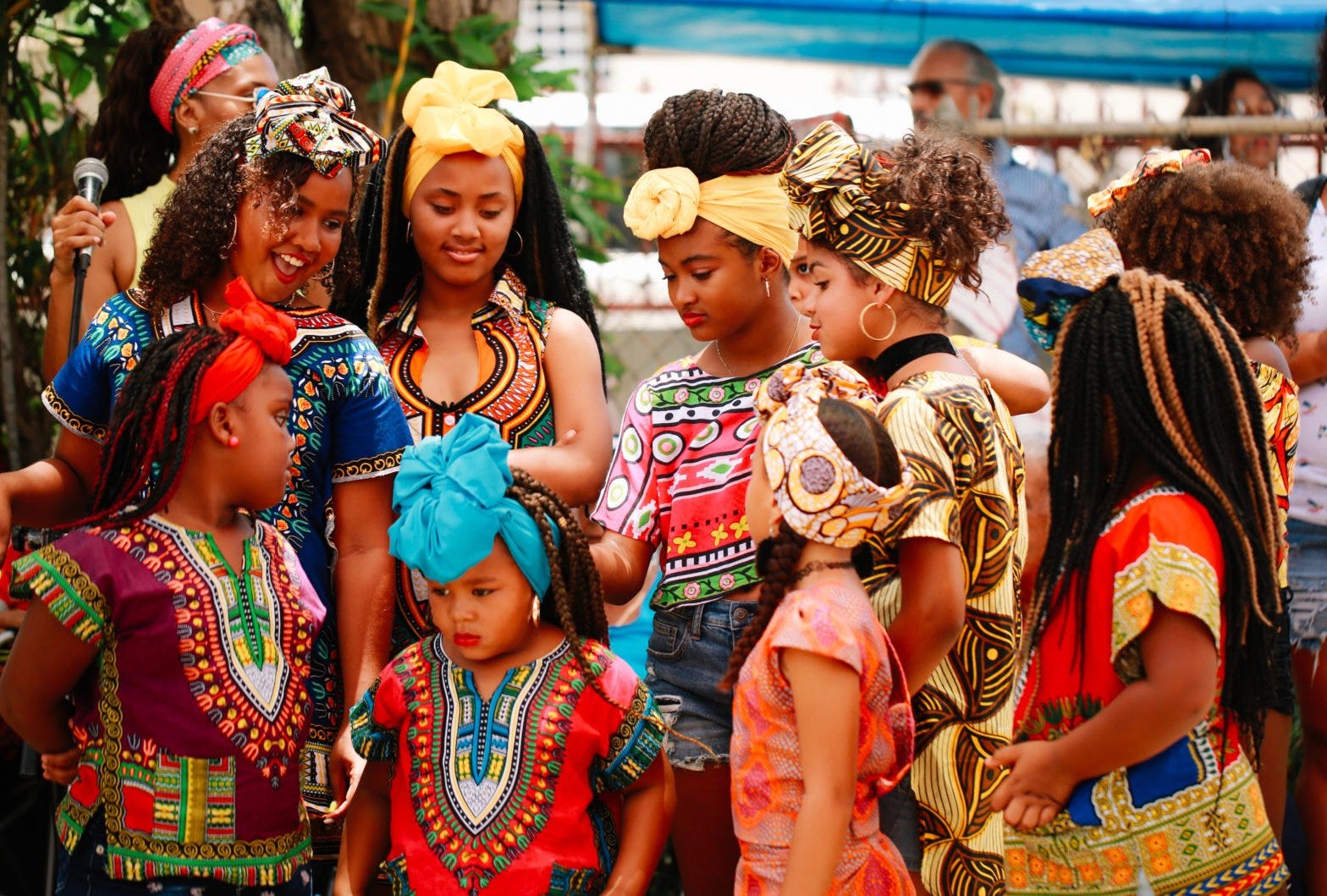
Loíza is a reality check because you can’t describe it honestly without describing Blackness. The U.S. Census Bureau QuickFacts estimates Loíza Municipio’s population as 34.2% “Black alone” and 12.1% “White alone” (Mind you, these are the boxes that people check. I’d bet a paycheck the number of Black residents is higher). That doesn’t capture every local meaning of Blackness, but it does undercut the claim that race is too “blurry” to matter.
Pulitzer Center reporting describes residents facing poverty, marginalization, and discrimination, including job discrimination tied to address—especially public housing. If someone insists Puerto Rico “doesn’t have race problems,” they’re asking you to treat that as either invisible or irrelevant.
The measurable consequences also show up in health. A study in the American Journal of Public Health reports that skin color can predict general health outcomes in Puerto Rico more strongly than standard racial categories and finds worse general health among darker-skinned Puerto Ricans compared with lighter-skinned Puerto Ricans.4
The Language Is the Evidence
People don’t develop a rich color vocabulary in a society where color carries no consequences. Research on Puerto Rican racial attitudes using skin-color scales notes salient categories—blanco, indio, trigueño, negro, and jabao—and treats these as socially meaningful distinctions.5
The everyday policing speaks louder: pelo malo versus pelo bueno (bad hair/good hair), mejorar la raza (improve the race), the little jokes that train kids to treat Afro-textured hair and darker skin as a problem to solve. The myth of harmony depends on that training.
↻ If this is naming something you’ve experienced or witnessed, hit the restack button—it helps this reach people who need it.
Brazil: Exporting the Racial Democracy Lie
Puerto Rico isn’t the only place that sells mixture as proof that racism ended. Brazil’s “racial democracy” myth did similar ideological work—exporting an image of harmony while racialized violence persists.
In 2023, police officers killed 6,393 people in Brazil, at an average rate of 18 deaths per day. Of these victims, 82.7 percent were identified as Black or Pardo Brazilian. This figure stands in stark contrast with Brazil’s demographics, where 53 percent of the population identifies with these ethnicities.
They exported this image globally while excluding actual Afro-Brazilian performers from mainstream productions. The myth persists even as scholars document what they call genocide. Abdias do Nascimento, a prominent Brazilian intellectual, spoke of the racism experienced by Black Brazilians as genocide, examining indexes of mortality, access to education, housing, and employment conditions that demonstrate the genocidal nature of structural racism in Brazil.67
Anti-Haitianismo: Rejecting Blackness as National Policy
The Dominican Republic shows another version: nationalism built against Blackness through anti-Haitianism. After Haiti occupied Santo Domingo from 1822 to 1844—liberating enslaved people and guaranteeing freedom—the Dominican Republic solidified its rejection of Blackness through antihaitianismo.
The humor is the weapon—it enforces the boundary while pretending not to mean it.
Scholars define antihaitianismo as an ideology that combines a legacy of racist Spanish colonial mentality, nineteenth-century racial theories, and twentieth-century cultural neoracism into a web of anti-Haitian attitudes, racial stereotypes, and historical distortions rooted in anti-Black prejudices that scapegoat Haitians as culturally and racially inferior.89
This culminated in the 1937 genocidal massacre under dictator Rafael Trujillo. Estimates of the death toll range from 9,000 to over 30,000, with scholarly consensus placing it between 12,000 and 20,000. And if that wasn’t enough, in 2013, the Dominican high court stripped citizenship from over 200,000 Black Dominicans of Haitian descent, rendering them stateless.10
Official identity cards categorize dark-skinned Dominicans as “indios“ or “morenos“ (anything but Black) reserving “Black” exclusively for Haitians.
The slur operates in daily life too. “Haitian” gets wielded against any Dominican considered “too dark,” often disguised as a joke. The humor is the weapon, it enforces the boundary while pretending not to mean it.
Brazil, the Dominican Republic, Puerto Rico: the scripts change but the function doesn’t. Understanding that matters for anyone trying to organize across Latino communities without reproducing the same erasures.
What This Changes About Organizing
Stop treating this as a culture-war argument about “identity.” Power decides who gets protected, who gets disbelieved, who gets to be unmarked. You are not stating some profound truth that elevates your Latin American nation above the United States, you’re reinforcing the exact sort of anti-Blackness you claim doesn’t exist in your homeland.
A non-erasing solidarity looks like:
Name anti-Black racism inside Latino communities, including diaspora spaces, without hiding behind “we’re all mixed”.
Treat colorism as material: it shapes health, work, housing, and safety.
Defend Black Puerto Rican self-definition, including the right to say “Black Puerto Rican/Afro-Boricua” without it being treated like a contradiction.
Follow Black local leadership and reporting, especially from places treated as disposable.
“Not hating Black people” is the bare minimum; you don’t get a cookie for that. The ruling class just needs you to accept the myth of racial democracy, take comfort in your relative proximity to whiteness, and never challenge the structure. Take Black History Month as your reminder to get educated and refuse the bribe.
What solidarity looks like in practice:
Share this with someone who still repeats the myth
Drop a comment: Where have you heard “I’m not Black, I’m ___” used as an escape hatch, and what did it protect?
Subscribe if you want more writing from someone who knows anti-Blackness is part of the system.
HASTA LA VICTORIA SIEMPRE.
Godreau, Isar P. Scripts of Blackness: Race, Cultural Nationalism, and U.S. Colonialism in Puerto Rico. University of Illinois Press, 2015.
Lloréns, Hilda, et al. Arrancando Mitos de Raíz: Guía para una enseñanza antirracista de la herencia africana de Puerto Rico. 2014.
Wade, Peter. “Rethinking Mestizaje: Ideology and Lived Experience.” Journal of Latin American Studies 37.2 (2005): 239-257.
Monk, Ellis P., Jr. “Skin Tone Stratification among Black Americans, 2001–2003.” American Journal of Public Health 104.1 (2014): 96-104.
Duany, Jorge. “Reconstructing Racial Identity: Ethnicity, Color, and Class among Dominicans in the United States and Puerto Rico.” Latin American Perspectives 25.3 (1998): 147-172.
Nascimento, Abdias do. Brazil, Mixture or Massacre?: Essays in the Genocide of a Black People. Afrodiaspora, 1989.
“The COVID-19 Pandemic and the Ongoing Genocide of Black and Indigenous Peoples in Brazil.” PMC, National Center for Biotechnology Information, 2020.
Sagás, Ernesto. “A Case of Mistaken Identity: Antihaitianismo in Dominican Culture.” Latin American Research Review, 1994.
COHA. “Antihaitianismo: Systemic Xenophobia and Racism in the Dominican Republic.” Council on Hemispheric Affairs, 2019.
Open Society Justice Initiative. “Dominicans of Haitian Descent and the Compromised Right to Nationality.” 2010; 2013 court ruling.